
Reviewed · VALENCIA
VALENCIA ESSENZIALE + SITI PATRIMONIO UMANITÀ (ITALIANO)
Valencia’s three UNESCO-listed cultural traditions and landmarks give this two-hour Italian walking tour a clear purpose. You visit the Silk Exchange, learn about the Water Tribunal, and hear why the Fallas festival, with its giant temporary sculptures and fireworks, belongs on the same international list.
I like the included entry to the Lonja de la Seda and City Hall, since paid admissions can quickly eat into a low-cost city tour. I also like the human touch: guides such as Sara add stories and local context rather than simply pointing out façades. The main drawback is pace. Two hours is enough for an introduction, not a slow look at every monument, and the optional tapa and drink costs extra.
Key points at a glance

- Three UNESCO properties in one walk: Learn about the Silk Exchange, the Water Tribunal, and the Fallas festival.
- Two useful admissions included: Enter the Lonja de la Seda and Valencia’s City Hall without arranging separate tickets.
- Italian-language guiding: The live tour is conducted in Italian, with bilingual guiding listed in the activity details.
- Easy central meeting point: Begin at the Tourism Hub inside Valencia’s North Station, beside Xàtiva Metro.
- Optional local bite: Add a tapa and drink at a city-center spot near the end of the walk.
- Short and accessible format: The tour lasts two hours, returns to the starting point, and is wheelchair accessible.
Why Valencia’s three UNESCO properties matter
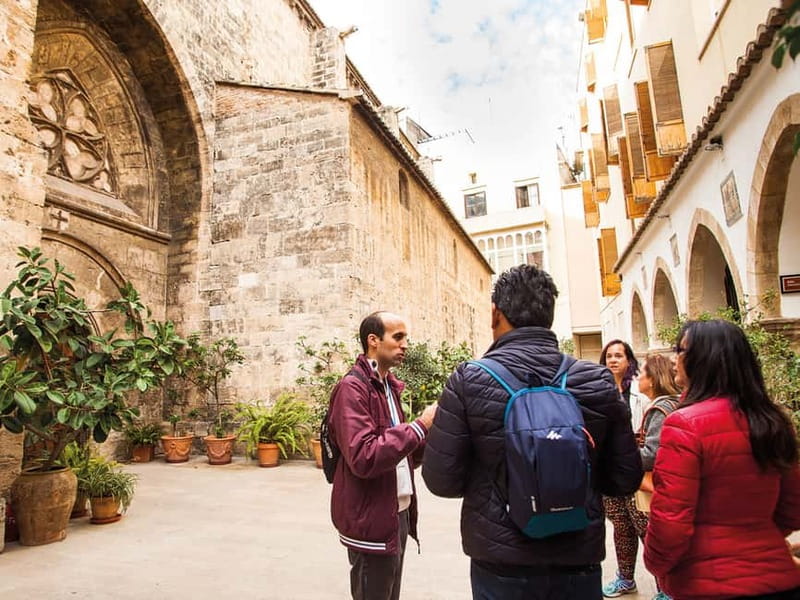
Many city tours collect famous buildings. This one has a more interesting thread: it connects a medieval trading hall, an old water-rights court, and a modern festival built around art, fire, and public celebration.
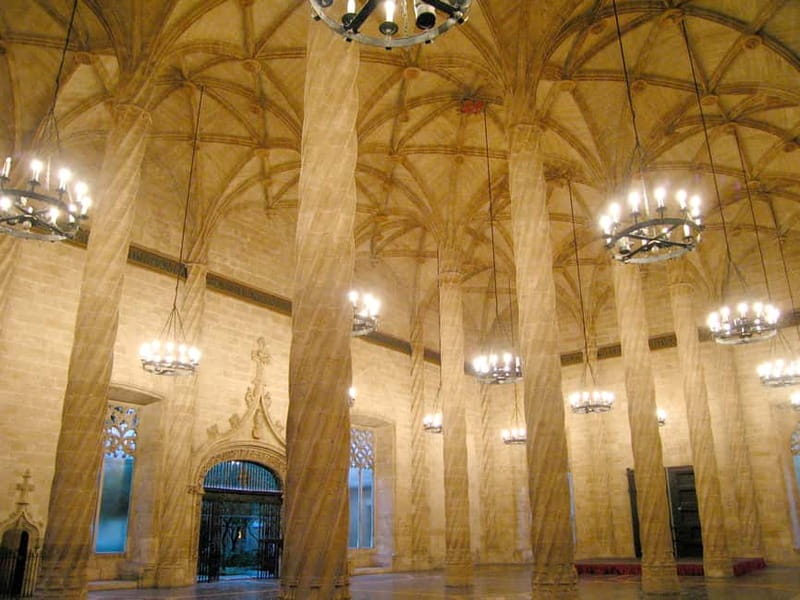
The Silk Exchange, or Lonja de la Seda, represents Valencia’s commercial power. Its inclusion gives the tour a strong architectural center. You will go inside, where the carved stone columns and formal trading spaces make more sense when your guide explains the role of merchants and the city’s place in Mediterranean commerce.
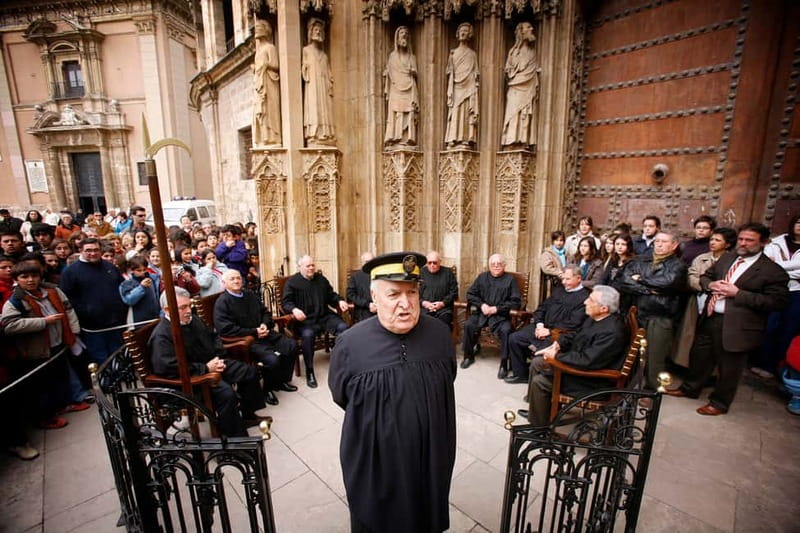
The Tribunal de las Aguas, or Water Tribunal, offers a different kind of heritage. It is not simply a monument to photograph. It reflects the practical system used to settle irrigation disputes among farmers. The point here is social history: how water was managed, who had authority, and how an old civic institution still forms part of Valencia’s identity.
The third property is the Fallas festival. This is not a single building you enter. It is an annual celebration known for huge temporary artworks, fire, and fireworks. The UNESCO connection helps you see Fallas as more than a noisy party. It is a local art form and a community tradition, even though its creations are designed to disappear.
That mix is the strongest idea in the tour. You are not getting three similar monuments. You are seeing three different ways a city preserves its culture: through architecture, public rules, and a festival that burns its own artwork.
Other Valencia outings people book on the same trip:
- Valencia: Oceanogràfic Entry Ticket
★ 4.7 · 9,893 reviews - Valencia: 24 or 48-Hour Hop-on Hop-off Bus Ticket
★ 3.9 · 5,611 reviews - Valencia: Palosanto Flamenco Show Ticket
★ 4.8 · 3,876 reviews
Starting at North Station in central Valencia
The meeting point is the Tourism Hub at Estación del Norte, Valencia’s main railway station. Look for the West Tower, the one on the right when you face the station, and go to the ground floor at Carrer de Xàtiva, 24.
This is a practical meeting spot. Xàtiva Metro station is nearby, and the railway station is easy to identify from the outside. Still, give yourself a few minutes to find the correct tower. A large station can turn a simple meeting into a last-minute search, especially if you arrive by Metro or train.
The tour ends back at the same meeting point. That makes the walk convenient if you have luggage nearby, a train to catch later, or a separate plan in Valencia’s center. No hotel pickup is provided, and transport is not part of the experience, so you must make your own way to North Station.
The published duration is two hours. Starting times depend on availability, so check the schedule before you build the rest of your day around it.
Entering the Lonja de la Seda
The Lonja de la Seda is the tour’s clearest architectural highlight. Your admission is included, which matters because you can see the interior rather than stopping outside with a quick explanation.
Inside, pay attention to the building’s relationship between business and ceremony. The name points to silk, but the building served a wider commercial purpose. This was a place where merchants met, negotiated, and handled trade in a city tied to Mediterranean commerce.
The guide’s role is especially useful here. A medieval stone hall can blur into a sequence of arches and columns if you do not know what you are looking at. A good explanation gives those spaces a job and a human scale. The tour’s strongest feedback centers on guides who tell stories clearly, and Sara is specifically praised for being kind and full of stories.
You should expect a guided visit rather than a long period for independent study. The tour has several major subjects to cover, so take a moment to look up and around as you move through the building. If architecture is your main interest, you may want to return later for more time.
Understanding the Water Tribunal
The Tribunal de las Aguas adds an unusual subject to a standard old-city walk. Water courts do not usually appear on a first-time sightseeing list, yet this institution helps explain how Valencia’s agricultural communities dealt with a scarce and valuable resource.
Your guide will introduce the tribunal as part of the city’s UNESCO heritage. The value is not just in seeing where proceedings take place. It is in understanding that Valencia’s culture grew from systems that had to work in everyday life, from trade inside the city to irrigation beyond it.
This stop may feel less immediately dramatic than the Lonja. There is no promise of a grand interior visit here, and the schedule does not specify a full court session. Think of it as a compact lesson in civic tradition rather than a major museum stop.
That is also why the Italian guide matters. Technical subjects can be hard to follow when you are walking and looking at monuments at the same time. Clear storytelling helps you connect the tribunal to the wider theme of Valencia’s long civic life.
Same city, a completely different afternoon:
- Valencia: Catamaran Cruise with Sunset Option
★ 4.0 · 3,566 reviews - Valencia Old Town Tour with Wine & Tapas in 11th Century Historic Monument
★ 5.0 · 3,234 reviews - Valencia: Oceanogràfic, Hemisfèric & Science Museum Combo
★ 4.4 · 2,959 reviews - Valencia: City Highlights Guided Bike Tour
★ 4.7 · 2,373 reviews
City Hall and the modern face of the center
Entry to Valencia’s City Hall is included. This gives the tour another interior visit and shifts the focus from medieval trade to municipal life.
The city hall stop helps round out the route. You are not seeing only religious or commercial buildings. You are also entering a working civic setting connected to how the city is governed and presented today.
The available details do not specify which rooms you will visit or how long you will stay inside. Keep your expectations sensible. The attraction is the chance to enter as part of a guided city walk, not a promise of an extended behind-the-scenes tour.
For many people, this is a good value point. Separate sightseeing costs can add up, and this tour includes two admissions for $21 per person. The price is especially fair if you want an orientation walk and would otherwise pay to see the Lonja and City Hall on your own.
What the Italian-language guide adds
The live guide speaks Italian. The activity also describes the guide as bilingual in English and Spanish, but the selected tour language is Italian, so confirm the language option when booking.
A guide changes the experience most at places where the meaning is not obvious. You can photograph the Lonja without help, but you may not understand the building’s commercial role. You can hear that Fallas uses fire, but the guide can explain why temporary public art belongs among Valencia’s UNESCO properties.
The named feedback about Sara is useful because it points to the style you can hope for: friendly guiding and plenty of stories. No individual guide is guaranteed, so do not book solely for a specific person. Still, the format clearly favors explanation and conversation over a silent route between monuments.
If you need to switch to another language group, that change depends on availability and carries an extra cost of €5 per person. It is better to choose the right language while booking than to count on changing later.
The optional tapa and drink
At the end, you can add a tapa and drink at a special city-center location near the finish. The guide will show you the place.
This is a pleasant way to finish a walking tour, especially if you want a small local food break rather than a formal meal. It also gives you a chance to ask follow-up questions after the main route has ended.
The tasting is optional. That distinction matters for budget planning, since the $21 price does not automatically include it. If you have a tight schedule, dietary concerns, or a meal already planned, simply choose the tour without the tasting option.
The information provided does not specify the exact tapa, drink, venue, or extra price. Treat it as an add-on rather than a guaranteed food itinerary. You will need to check the available option at booking.
Is two hours enough for Valencia’s essential sights?
Two hours works well for a first look. You get a clear route, two included admissions, and an explanation of three UNESCO properties without committing half a day.
The tradeoff is depth. Valencia has more than 21 centuries of history and monuments from many periods. No two-hour walk can do justice to all of them. The tour focuses on selected essentials, so you will not receive a full survey of every church, square, museum, and neighborhood.
I would use this as an orientation on an early day in Valencia. Afterward, you will know which subjects deserve more of your time. You might return to the Lonja for a slower visit, explore more of the center independently, or plan around Fallas if your dates match the festival.
The schedule also calls for walking between stops, though the supplied information does not give the distance or group size. Wear comfortable shoes and bring a protective face covering, which is listed among the items to bring.
Accessibility, cost, and booking flexibility

The activity is listed as wheelchair accessible, an important practical point for anyone checking routes in an old city. Specific details about surfaces, step-free access at every entrance, and accessible restrooms are not provided, so ask the operator if you need precise arrangements.
At $21 per person, the tour offers solid value if you want a guide and plan to enter both the Silk Exchange and City Hall. The price is less compelling if you prefer to walk alone, skip interiors, or already know Valencia’s central monuments well.
You can cancel up to 24 hours in advance for a full refund. You can also reserve now and pay later, which helps if your schedule is still moving around. Those policies are useful, but the main value comes from the compact route and included entries.
No hotel transfer or public transport is included. You are responsible for reaching North Station and returning from the finish, although the route ends at the same meeting point.
Who should book this Valencia walk?
I would recommend it to a first-time visitor who wants a short introduction before exploring alone. It suits anyone interested in architecture, civic traditions, and cultural festivals rather than only famous photo stops.
It is also a good match for Italian-speaking visitors who want more than a self-guided audio route. A guide such as Sara can make the city’s unusual subjects, especially the Water Tribunal and Fallas, easier to grasp.
Families and mixed-age groups may appreciate the two-hour length, though the pace and walking format still require attention from younger children. Wheelchair users can consider it because accessibility is listed, but should confirm the details for each interior.
I would look elsewhere if you want a food tour, a long museum visit, or a broad city excursion covering every major district. The tapa is an optional ending, not the main purpose, and the route stays focused on Valencia’s central heritage.
Should you book it?
Book this tour if you want a low-cost introduction with real cultural substance. The included entries to the Lonja de la Seda and City Hall give the $21 price practical value, while the Water Tribunal and Fallas explain why Valencia’s heritage goes beyond grand buildings.
Skip it if you dislike guided pacing or have already spent time inside these sights. For most first visits, though, the mix is well judged: two hours, a central meeting point, an Italian-speaking guide, and three very different UNESCO stories. Add the tapa and drink only if you want a social finish and have room in your schedule.
FAQ
What language is the tour conducted in?
The live tour guide speaks Italian. The activity also lists English and Spanish for the bilingual guide service. Changing to another language group depends on availability and costs an extra €5 per person.
How long does the walking tour last?
The tour lasts two hours. Starting times vary, so check availability when selecting your date.
Where does the tour start?
It starts at the Tourism Hub inside Valencia’s Estación del Norte, at the West Tower on the right when facing the station, on the ground floor at Carrer de Xàtiva, 24. Xàtiva Metro station is nearby.
Where does the tour end?
The activity ends back at the meeting point.
Are admission tickets included?
Yes. Admission to the Lonja de la Seda and Valencia’s City Hall is included.
Is the tapa and drink included?
You can choose a tour option with a tapa and drink tasting at the end. The tasting is optional, and the available information does not state its exact extra price.
Just added to the Valencia listings
- Visit the most beautiful village in Valencia: Chulilla★ 5.0 · 14 reviews
- Walking Tour through Valencia’s Historic Centre★ 5.0 · 19 reviews
- Windsurf class on Valencia beach★ 4.3 · 4 reviews
- Valencia: Guided Mountaineering Experience★ 3.7 · 4 reviews
- Valencia: World of Illusions Museum Entrance Ticket★ 4.0 · 22 reviews
- Valencia: Gourmet Food & Wine Tour★ 4.2 · 6 reviews
- Valencia: Wine Gogh Glow Academy Paint and Sip Classes★ 4.2 · 18 reviews
- Valencia: Wine Tasting and Tapas Experience★ 4.5 · 38 reviews