
Reviewed · CITY OF ARTS AND SCIENCES TOURS
Valencia: City of Arts and Sciences Private Walking Tour
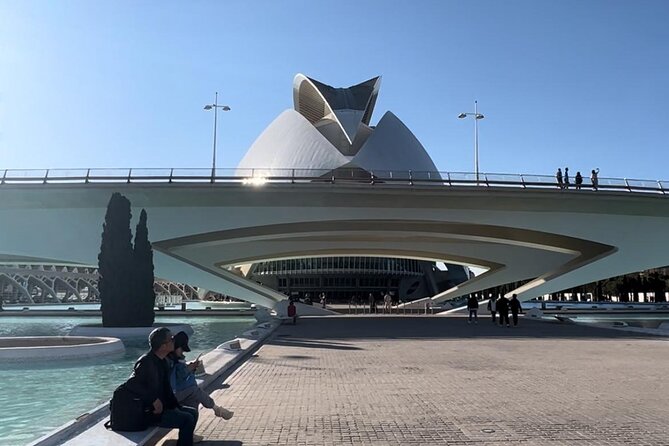
Valencia’s City of Arts and Sciences is best understood from the outside first. Santiago Calatrava’s white buildings curve, stretch, and reflect across the water like a science-fiction city, and a private guide helps connect those bold shapes to their purpose. You’ll see the Hemisfèric, Science Museum, Oceanogràfic, Palau de les Arts, and Umbracle in about two hours.
I like the private format, since your group can focus on architecture without being folded into a large crowd. I also like the clear theme: this is not a rushed museum visit but a close look at Valencia’s modern identity. The main drawback is just as clear: interiors and admission tickets are excluded, so you’ll need a separate plan if you want the aquarium, science exhibits, or a show.
Key points to know before booking
- Exterior architecture only: The tour visits the outside of every major building, including the Hemisfèric, Oceanogràfic, Science Museum, Palau de les Arts, and Umbracle.
- Private guide for your group: Guides named in the tour information include Sonnia, Jose, Amir, and Jose Luis.
- Two-hour introduction: The timing works well as a first look before returning later for an aquarium visit, museum admission, or performance.
- A strong choice for design lovers: The focus is on Santiago Calatrava’s forms, engineering, construction, and the complex’s role in Valencia.
- Meeting point at Barceló Valencia: The tour begins and ends at Av. de França 11, with transportation not included.
- Price reflects privacy: At $139.03 per person, the value depends on your group size and how much you want guided architectural context.
Why this modern complex deserves a guided walk
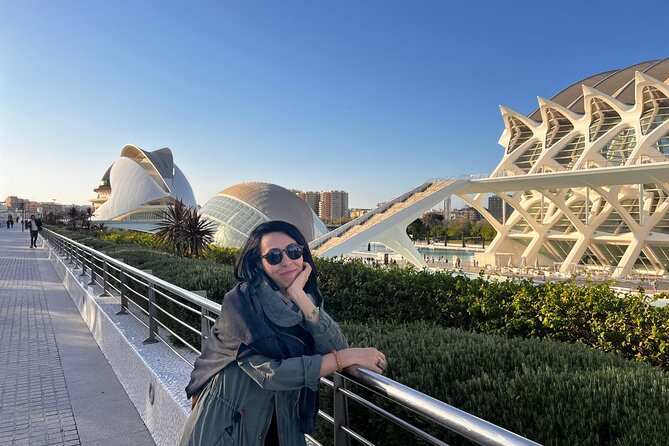
Valencia is known for old streets, markets, and traditional architecture, but the City of Arts and Sciences shows a very different side of the city. Here, the main attraction is not a single historic monument. It is a broad complex of futuristic buildings designed to make science, art, nature, and performance feel like parts of one grand idea.
I find the outside of the complex especially effective because the buildings are designed to be viewed from many angles. White ribs, sweeping shells, pools, and long lines change as you walk. A guide can point out why a building has its particular form rather than leaving you with a collection of impressive photographs and no context.
That context matters here. The structures can look beautiful but puzzling. Why does one resemble an eye? Why does another look like the skeleton of a giant sea creature? What is the purpose of the long garden walkway? The tour is built around those questions.
This is also a useful way to get your bearings. The complex is large, and two hours gives you enough time to see its main architectural features without committing a full day to every attraction. If you later decide to visit the interiors, you will already understand how the buildings fit together.
More City of Arts and Sciences visits
- Valencia: Oceanogràfic Entry Ticket
★ 4.7 · 9,893 reviews - Valencia: Oceanogràfic, Hemisfèric & Science Museum Combo
★ 4.4 · 2,959 reviews - Valencia: Principe Felipe Science Museum Entry Ticket
★ 4.3 · 1,039 reviews
Starting at the Hemisfèric
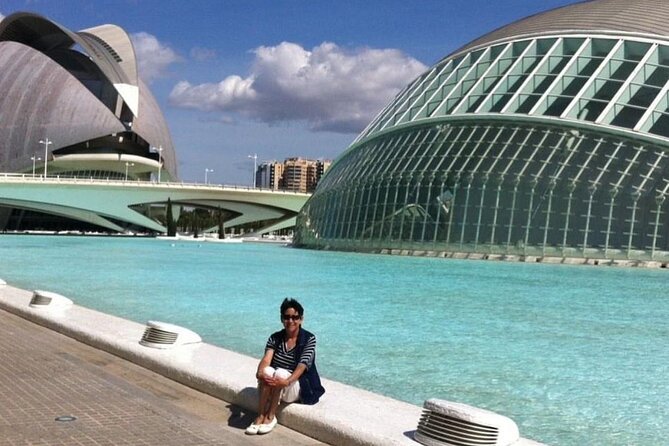
The tour begins at the Hemisfèric, one of the easiest buildings to recognize. Its eye-shaped design reflects in the surrounding water, creating the image of a giant eye looking across the complex.
That reflection is not a minor detail. It helps explain the building’s visual power. The Hemisfèric is meant to be seen as both architecture and image, with the water extending its shape and making the structure feel larger than it is. This is an ideal opening stop because it introduces the main idea of the complex: science and technology presented through theatrical design.
Your guide may also help you read the building as part of Calatrava’s wider approach. The focus is not simply on decoration. Curves, symmetry, white surfaces, and water work together to create a strong visual statement. Guides such as Sonnia, Jose, and Amir have been praised for explaining the design and purpose of the buildings in a clear, engaging way.
Remember that the tour does not include entry to the Hemisfèric. You are looking at the exterior, learning about its role, and viewing it from the public areas around the structure.
The Science Museum and its giant skeleton form
Next comes the Príncipe Felipe Science Museum. Its long, ribbed shape is often compared to a whale’s skeleton, and that comparison helps you see how the building’s repeated structural elements create both rhythm and movement.
This is where the tour’s architectural focus becomes especially useful. From a distance, you may simply see an enormous white frame. Up close, the repeated ribs and open spaces show how the building creates a sense of lightness despite its scale. Your guide can explain the relationship between the building’s form and its purpose as a science museum.
I like this stop because it rewards slow looking. The Science Museum is not a compact monument that you understand in one glance. Its size, repetition, and unusual form become clearer as you move along it.
The practical limit is that you will not see the exhibits. If interactive science displays are your main reason for coming, this walking tour is only an introduction. If your interest is architecture, the exterior may be enough to justify the stop, especially with a guide explaining how the structure was conceived and built.
Walking around the Oceanogràfic
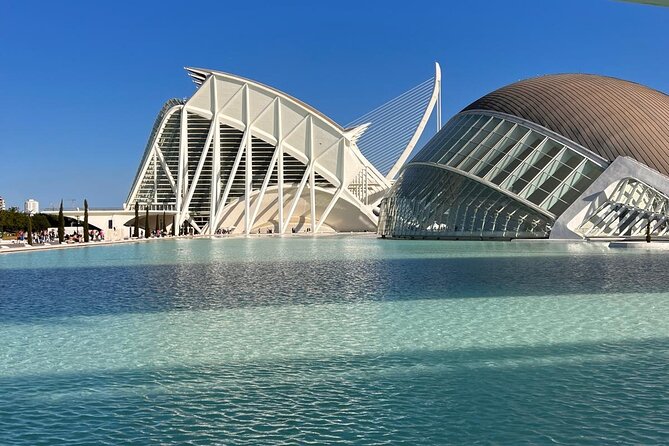
The Oceanogràfic is described as the largest aquarium in Europe, and its exterior fits the subject. The building uses smooth, organic forms inspired by the sea, with a shape that feels less like a conventional building and more like a set of flowing marine structures.
This part of the walk connects the complex’s architecture with nature. The forms are not sharp and rigid in the same way as a standard institutional building. They bend and open, echoing waves, shells, and underwater life without copying any one creature too literally.
You should be clear about what you are buying here. The tour takes you around the outside of the aquarium. It does not include aquarium admission, and the description does not promise access to tanks or indoor areas. If you want to see the marine exhibits, plan a separate visit and budget for a separate ticket.
Still, the exterior is a worthwhile part of the walk. You get a sense of the Oceanogràfic’s scale and its place within the larger complex. A guide can also help you compare its organic forms with the sharper lines of the Science Museum and the more theatrical shape of the Hemisfèric.
More walking tours in Valencia
- Valencia: Essentials and World Heritages Sites Walking Tour
★ 4.7 · 684 reviews - Valencia: Historical Walking Tour
★ 4.6 · 390 reviews - Valencia: City Walking Tour with Top Attractions – ITALIAN
★ 4.9 · 242 reviews - Valencia Private Walking Tour with Official Valencian Guide
★ 5.0 · 176 reviews
The Palau de les Arts Reina Sofía
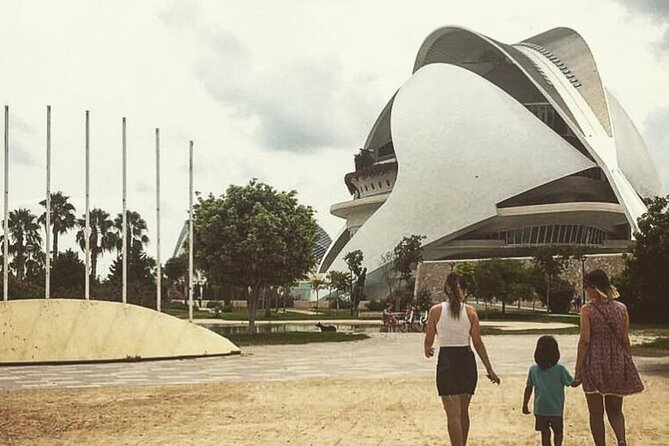
The Palau de les Arts Reina Sofía is the complex’s tribute to the performing arts. Its sculptural design is broad, curved, and dramatic, making it one of the buildings that is easiest to experience as a piece of visual theatre.
This is an important stop because it shows that the City of Arts and Sciences is not only about laboratories, aquariums, and science displays. Music and performance are part of the plan too. The building’s flowing form reflects that purpose, giving the complex a cultural side that is easy to miss if you are only chasing the best photo.
The guide’s role here is to explain how the building functions and how it fits into the original vision for the site. Several guides named in the tour information, including Jose and Sonnia, are praised for explaining the purpose and creative thinking behind each structure.
Again, the visit is exterior only. You will not attend a performance or tour the inside as part of the standard experience. If you are booking because of a particular opera, concert, or interior design interest, contact the local agency about adding an interior visit before assuming it is included.
Finishing at the Umbracle
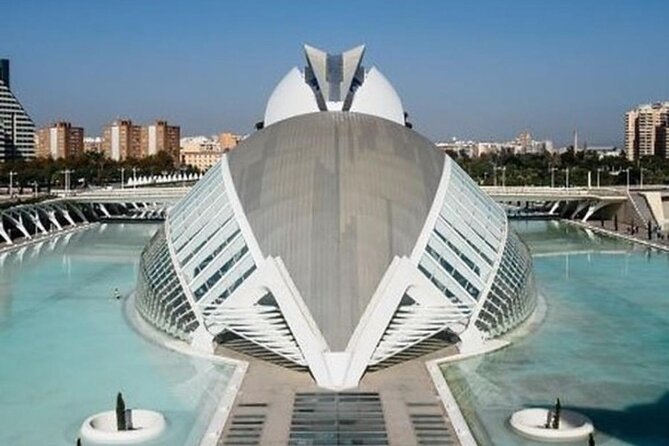
The Umbracle provides a change of pace. Instead of a single enclosed building, it is a garden and walkway designed to frame views across the complex.
This is a smart final stop for a two-hour tour. After seeing the major structures from ground level, you can look back across the site and understand how the buildings relate to one another. The Umbracle also offers panoramic views of the complex, making it a natural place for photographs.
I would pay attention here to the contrast between planting, open air, and hard white architecture. The garden walkway gives the futuristic buildings a softer setting. It also helps explain why the complex feels like more than a row of museums. The spaces between the buildings are part of the design.
The Umbracle is also useful if you want a final overview before deciding what to visit next. From here, you can think about whether the aquarium, museum, or Hemisfèric suits your interests. The private guide can help you make sense of the choices, though admission is not part of the tour price.
What the private format adds
A private tour means only your group participates. That changes the experience in practical ways. You are not listening over a large crowd, and the guide can shape the conversation around your interests.
If your group includes an architecture enthusiast, you can spend more time on Calatrava’s design choices. If someone in your party is more interested in the history and construction of the complex, you can ask about that instead. The supplied guide information names Sonnia, Jose, Amir, and Jose Luis, all associated with positive comments about making the buildings easier to understand.
That flexibility is the main reason to consider this tour instead of simply walking around alone. The complex is visually obvious but not always easy to interpret. A guide adds the story behind the shapes, including how the architecture blends science, art, nature, and performance.
The tradeoff is price. At $139.03 per person, this is not a cheap orientation walk, especially for one or two people. The value improves for a group that wants a private conversation and does not want to join a standard group tour. Group discounts are available, but the exact savings are not provided, so check the total before booking.
Timing, meeting point, and practical limits
The tour lasts about two hours. It starts and ends at Barceló Valencia, Av. de França 11, in the Camins al Grau area. Transportation is not included, so you need to arrange your own way to the meeting point and back.
Ending where you began is convenient if you have other plans nearby. It also keeps the activity simple: no complicated transfer, no need to leave a vehicle at a different location, and no extra transport segment included in the schedule.
The tour is available with a mobile ticket, and confirmation is received at booking. Service animals are allowed, and the activity is near public transportation. Most people can participate, according to the supplied practical information.
The biggest planning point is the exterior-only format. Bring the right expectations. This is not a museum tour, aquarium visit, or performing arts experience. It is a guided walk around the buildings, with the emphasis on design and meaning.
Valencia can also be bright and warm, though the supplied details do not provide weather advice or a specific shade plan. Since the experience takes place outside, sensible walking clothes and sun protection are worth considering. That is practical advice, not an included feature of the tour.
Who will enjoy this tour most
I would recommend it first to people who notice buildings before exhibits. If you enjoy modern architecture, photography, design, or the story of how a city presents itself, the two-hour route gives you a focused introduction.
It also suits first-time visitors who want to understand the City of Arts and Sciences before buying separate admission tickets. You can see the whole complex, hear how the buildings relate to one another, and then choose which interiors deserve more of your time.
Families and mixed-interest groups may also find the private format helpful. One person can ask about engineering, another about cultural use, and another about the best views. The guide can keep the discussion moving instead of following a fixed speech for a large group.
I would be more cautious if you want hands-on science, aquarium tanks, or a performance. None of those are included. The tour makes sense as an architectural introduction, not as a replacement for the attractions inside.
Is $139.03 per person good value?
The price is reasonable only if you value private guiding. The buildings are visible without admission, so someone interested mainly in taking photographs can explore independently for less.
You are paying for interpretation, structure, and a dedicated guide. That matters because the City of Arts and Sciences is big, highly visual, and full of unusual forms. A good explanation can turn a collection of striking façades into a coherent story about Valencia’s modern side.
The price also makes more sense for a group that can use the private format well. Ask questions, compare the buildings, and discuss which interiors to visit later. If you simply want a short walk and a few pictures, the cost may feel high.
The tour is often booked 46 days ahead on average, so planning early is sensible if you need a particular date or want to coordinate it with other Valencia plans. Free cancellation is available until 24 hours before the start time. Changes or cancellations made inside that window are not refunded or accepted.
Should you book the City of Arts and Sciences walking tour?
Book it if you want the buildings explained, not just photographed. The route covers the complex’s major exterior sights, and the private setting gives you room to ask about Calatrava’s design, construction, and the role of science, nature, and art in the site.
Skip it if your priority is going inside. Admission is not included, and this experience does not cover the aquarium, museum exhibits, Hemisfèric programs, or performances. In that case, plan interior tickets separately, or ask the local agency about adding a building visit.
For architecture lovers, this is the stronger choice. For everyone else, it is a useful two-hour orientation that helps you decide what deserves more time. The most praised qualities are the guides’ ability to explain the unusual designs and the way the tour reveals a different, modern side of Valencia.
FAQ
How long does the City of Arts and Sciences private tour last?
The tour lasts approximately two hours.
Is this a private tour?
Yes. Only your group participates in the activity.
Which buildings are visited?
The route covers the Hemisfèric, Príncipe Felipe Science Museum, Oceanogràfic, Palau de les Arts Reina Sofía, and Umbracle.
Are the building interiors included?
No. The standard experience visits the exteriors only. You can contact the local agency to ask about adding an interior visit.
Is admission included in the price?
No. Admission tickets are not included.
Where does the tour begin and end?
It begins and ends at Barceló Valencia, Av. de França 11, Camins al Grau, 46023 València, Spain.
Is transportation included?
No. Transportation is not included in the tour.
Can I cancel for a full refund?
Yes, if you cancel at least 24 hours before the experience starts. Cancellations or changes made less than 24 hours before the start time are not accepted, and the payment is not refunded.
Just added to the Valencia listings
- Visit the most beautiful village in Valencia: Chulilla★ 5.0 · 14 reviews
- Walking Tour through Valencia’s Historic Centre★ 5.0 · 19 reviews
- Windsurf class on Valencia beach★ 4.3 · 4 reviews
- Valencia: Guided Mountaineering Experience★ 3.7 · 4 reviews
- Valencia: World of Illusions Museum Entrance Ticket★ 4.0 · 22 reviews
- Valencia: Gourmet Food & Wine Tour★ 4.2 · 6 reviews
- VALENCIA ESSENZIALE + SITI PATRIMONIO UMANITÀ (ITALIANO)★ 4.7 · 3 reviews
- Valencia: Wine Gogh Glow Academy Paint and Sip Classes★ 4.2 · 18 reviews
City of Arts and Sciences Tours, compared.

Oceanogràfic, Hemisfèric & Science Museum Combo
Read our review →

City of Arts and Science 3D Movie at Hemisfèric
Read our review →

Browse the lists this tour appears in